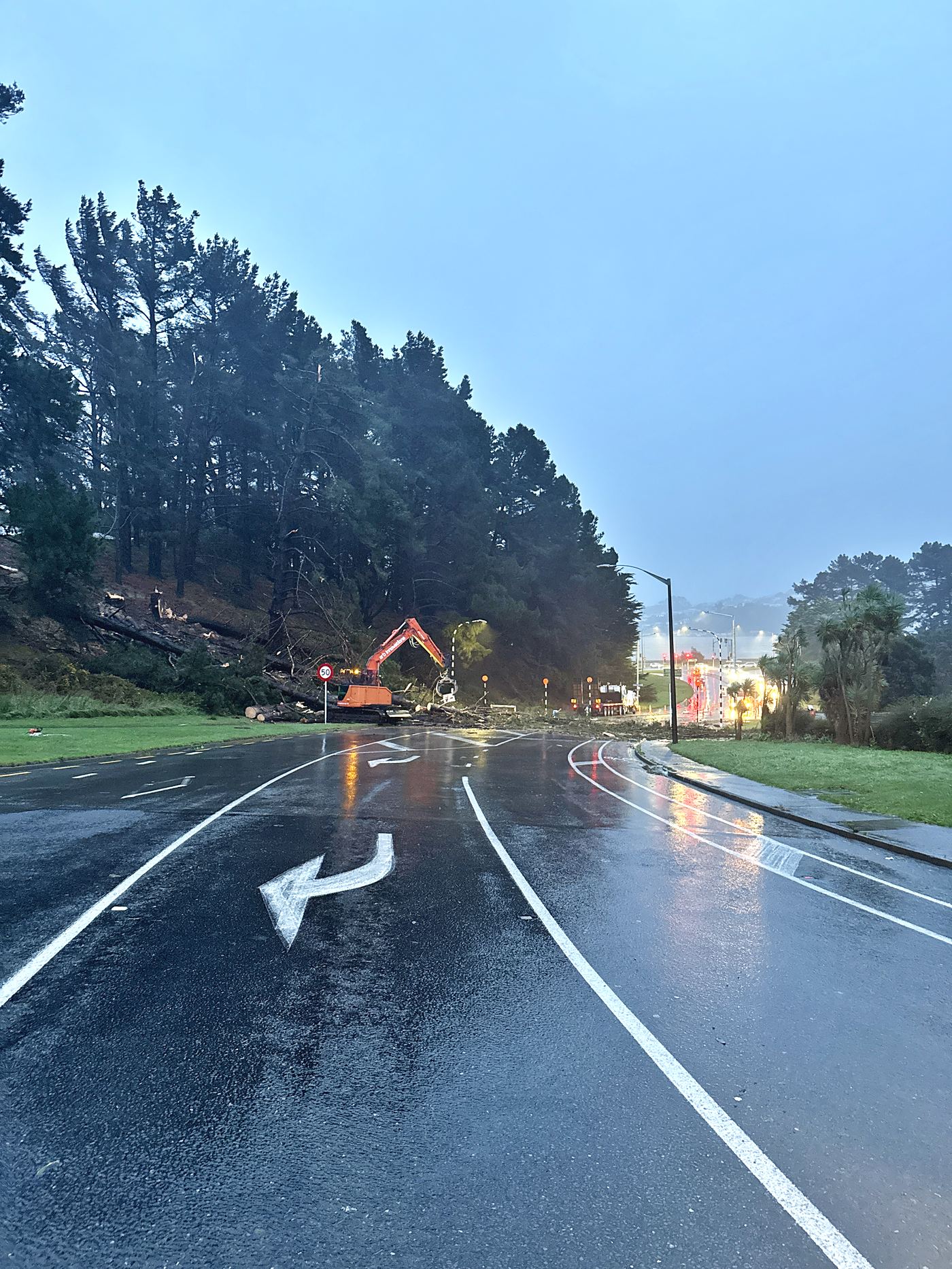
Storm damaged trees
Storm-damaged trees are the most dangerous work we do. A hung-up limb or a partially uprooted stem holds enormous stored energy and releases it without warning.
First — stay away from it
What to do before anyone arrives.
Wellington gets weather. After a serious blow we get calls about trees on fences, trees on roofs, trees leaning on other trees, and root plates lifting out of saturated ground.
The instinct is to go and look, or to start cutting. Please don't. Storm-damaged trees are under loads that aren't visible from the ground.
Assume every downed or low line is live. Keep people and animals well clear and call the network operator — Powerco on 0800 27 27 27 — or 111 if anyone is in danger.
Don't cut a tree that's leaning on something. Hung-up trees release stored energy unpredictably. This is how people are killed.
Stay out from under a lifted root plate. A partially uprooted tree can drop back as violently as it came up.
Keep clear of split and hanging limbs. A limb hung in a canopy can come down hours or days later in no wind at all.
Photograph it from a safe distance. Useful for us, and for your insurer.
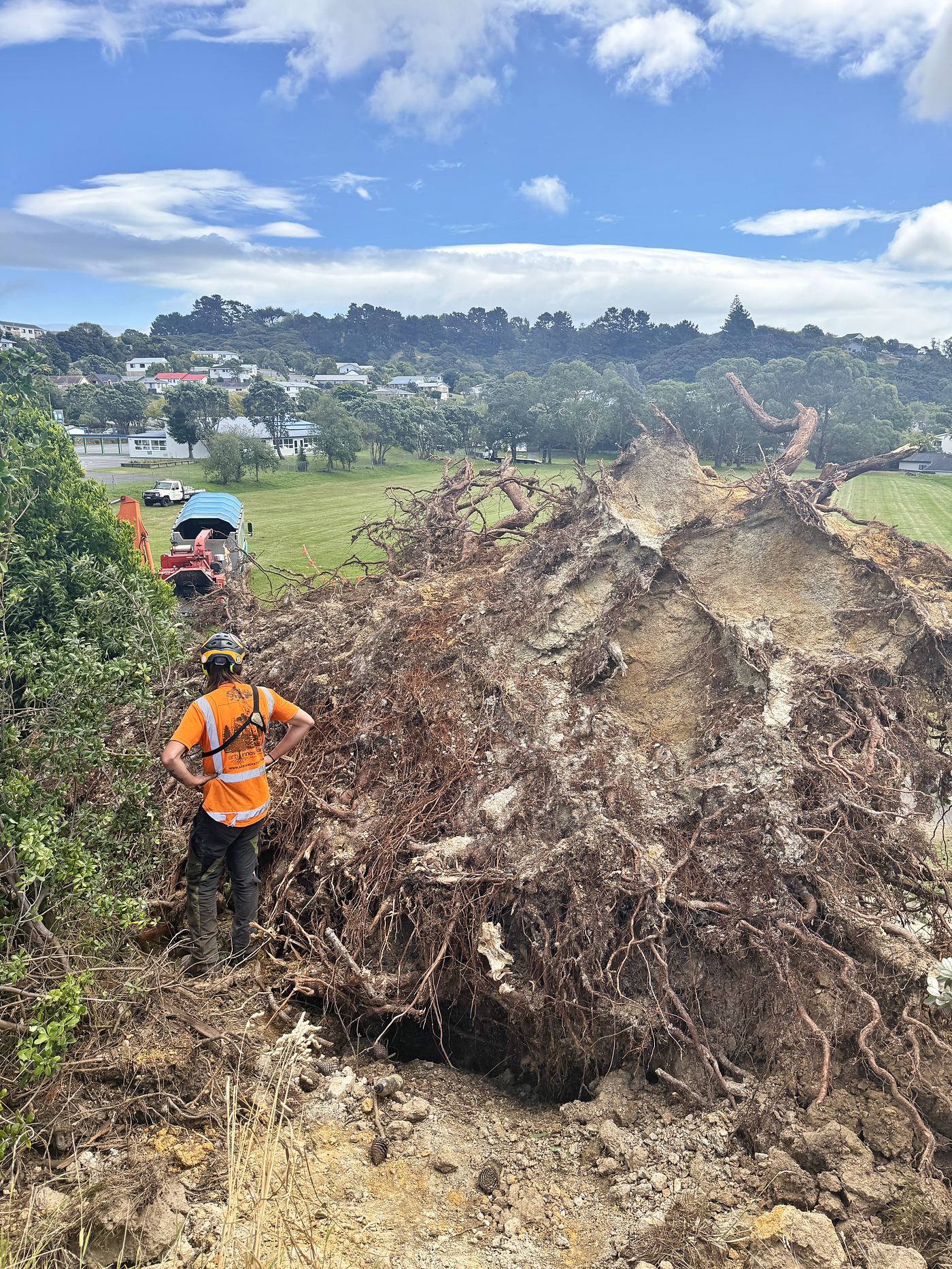
Root plate failure
The ground lets go before the tree does.
In saturated ground a perfectly healthy tree can still come over, because it is not the stem that gives way — it is the soil. The plate lifts, and what is left standing on edge is several tonnes of root, rock and earth.
A partially lifted plate is the most dangerous thing on a storm site. It can drop back into its hole as violently as it came out, and it does not need any wind to do it. Nobody should be under it or behind it until it is secured or down.
After a bad night
Access first, then everything else.
One tree across a road can cut off a valley. After a serious blow the first job is usually not the worst tree on the list — it is the one stopping anyone from reaching the others.
So a route gets worked in that order: open it enough to get plant and people through, make the standing hazards safe, then come back for the full clean-up once nothing overhead is still holding tension.
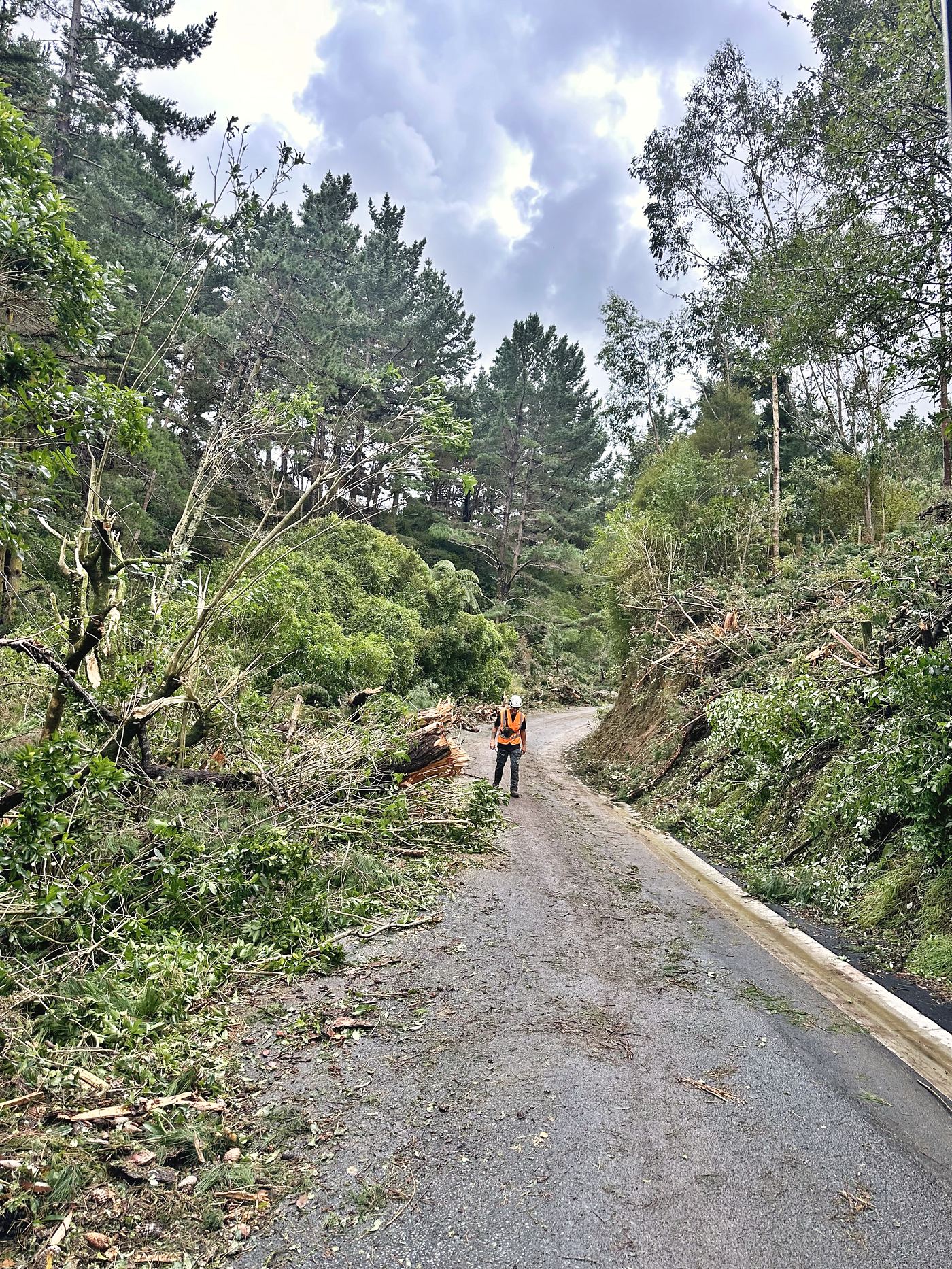
What we do
Make safe first, tidy up second.
Our first job is to make the site safe — remove the immediate hazard, get the load off whatever it's resting on, and take down anything likely to come down on its own. Full clearance and clean-up follow once nothing is under tension.
Where lines are involved we work within our network approvals, and we hold Wellington Electricity's authorisation for close work within four metres on both high and low voltage. In the Wairarapa and Manawatū we're an approved Powerco contractor. That matters after a storm, because it means we don't have to stand back and wait for someone else.
We can provide written assessments for insurance claims, and where a tree failed because of a defect that should have been managed, we can say so.
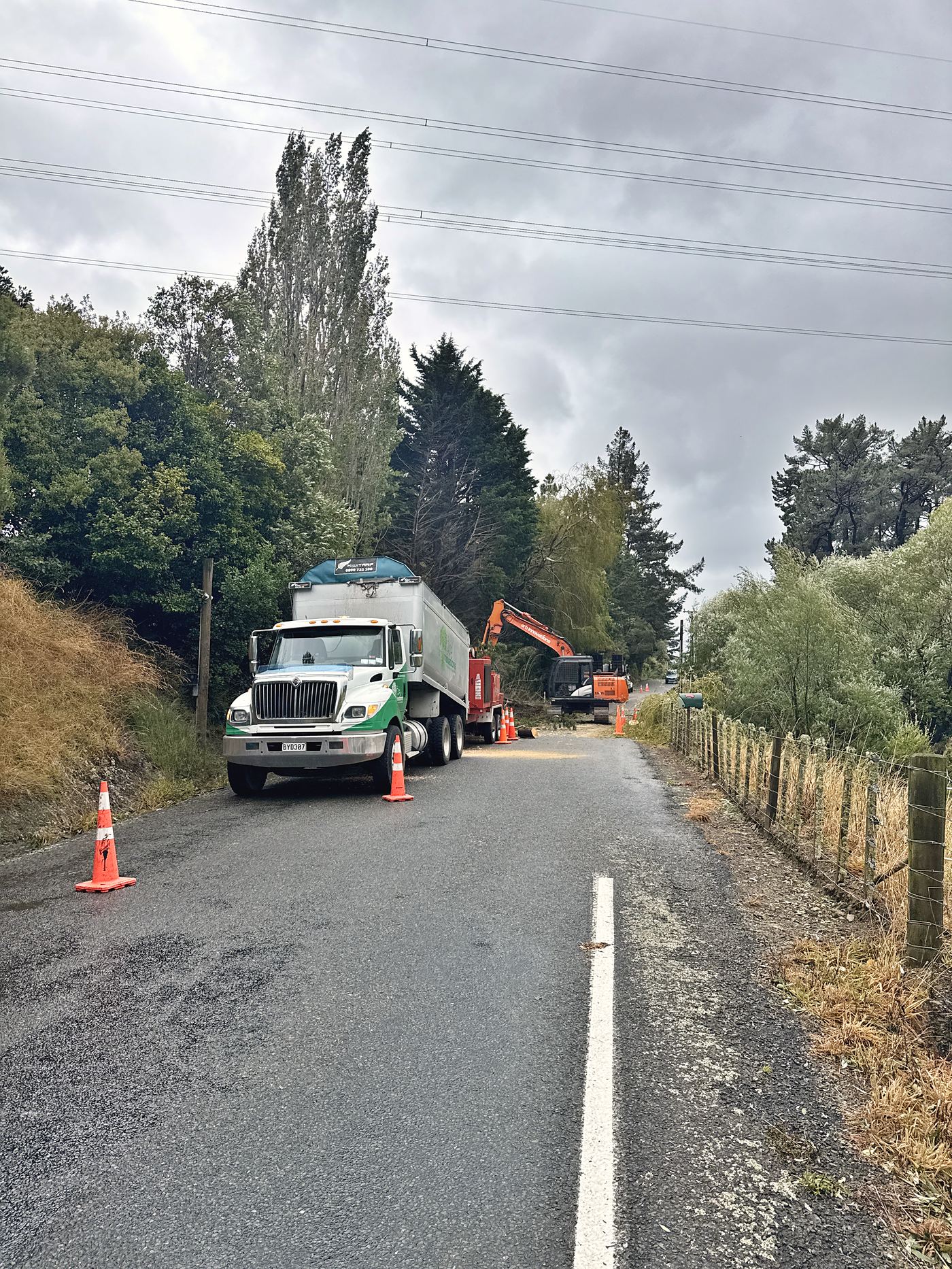
On the road
Cones and signage before a saw starts.
Roadside work needs traffic management in place before anything is cut. On a through road that is not an afterthought — it usually decides how the whole day is sequenced, and it is the part that keeps the public out of a work zone full of moving timber.
The chippers, tip trucks and excavators are ours. On a storm callout that is the difference between clearing a site today and coming back tomorrow with the right machine.
Our in-house HSEQ coordinators keep the safety documentation, inductions and training records current for the whole crew and any subcontractor we bring in. On an emergency callout that means the compliance side is already done before the phone rings.
Common Questions
Frequently asked
Do you do after-hours call-outs?
Yes. For anything involving power lines, call the network operator first — Powerco on 0800 27 27 27 — or 111 if there's immediate danger.
Will my insurance cover storm damage to trees?
That's between you and your insurer, and cover varies considerably. Most policies deal with damage the tree caused to property rather than the cost of the tree work itself. We can provide a written assessment and photographs to support a claim.
Can you make it safe today and clean up later?
Usually, and often that's the sensible sequence. Removing the immediate danger is quick; full clearance can be scheduled once nothing is under load.